Become the clearest, most trusted name in your market
Jul 13, 2026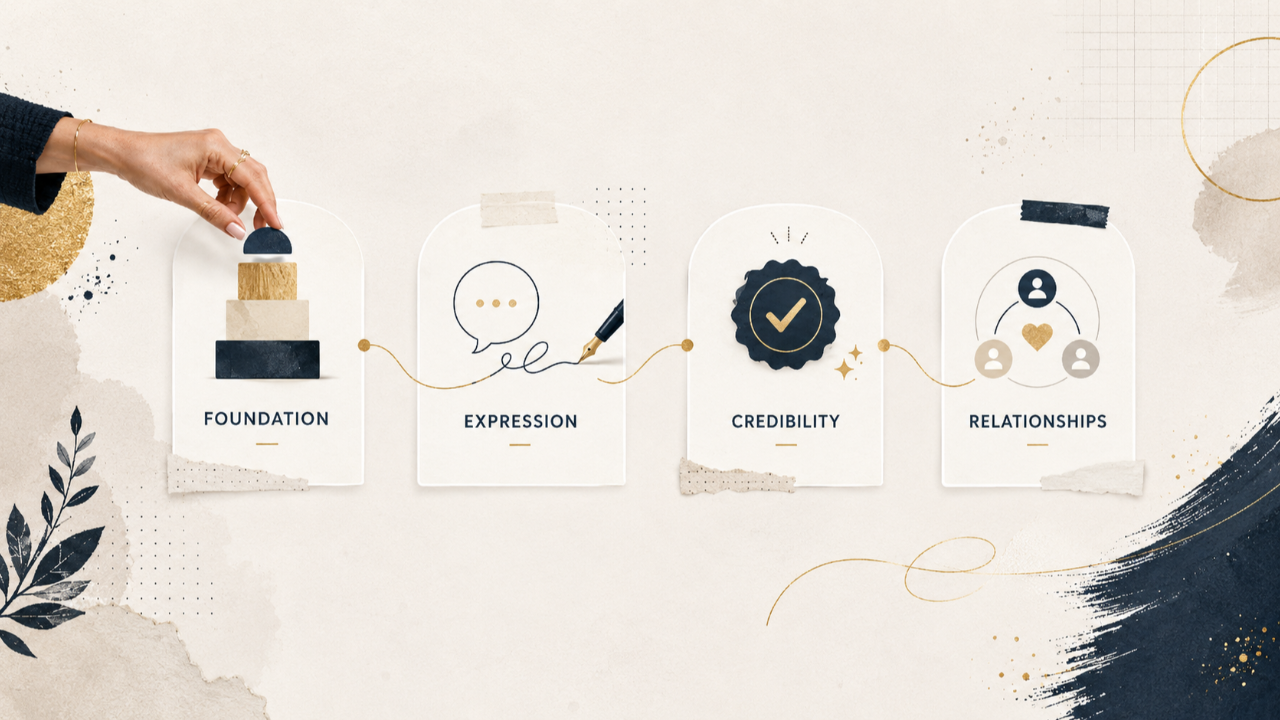
Being trusted isn't the same as being liked.
Liked is nice. Liked gets a warm comment, a friendly nod, maybe a "love this" on LinkedIn.
Trusted gets chosen.
That's the difference.
If you run a founder-led business, trust isn't built by sounding polished for the sake of it. It's built when people understand what you do, feel the steadiness behind your thinking, and see enough proof to believe you can help.
This is why I keep coming back to the same idea:
Become the clearest, most trusted name in your market.
Not the loudest. Not the busiest. Not the one who posts seven times a day and slowly becomes a stranger to themselves.
The clearest. But how?
Trust starts when people understand you
People can't trust what they don't understand.
They might admire it from a distance. They might sense there's something good in there. They might even save the post and tell themselves they will come back later, which is where saved posts go to live a quiet and mysterious life.
But trust needs more than a vague positive feeling. It needs shape.
Your market needs to understand:
• what you do
• who you help
• what problem you solve
• how you think
• why your work matters
• what proof supports it
• what the next step is
When these pieces are scattered, trust leaks.
That's why brand misalignment can feel so frustrating. Nothing is technically broken, but something isn't landing. There's an "urgh" feeling. You keep adjusting the words, but the problem sits underneath them.
The four parts that help a brand hold
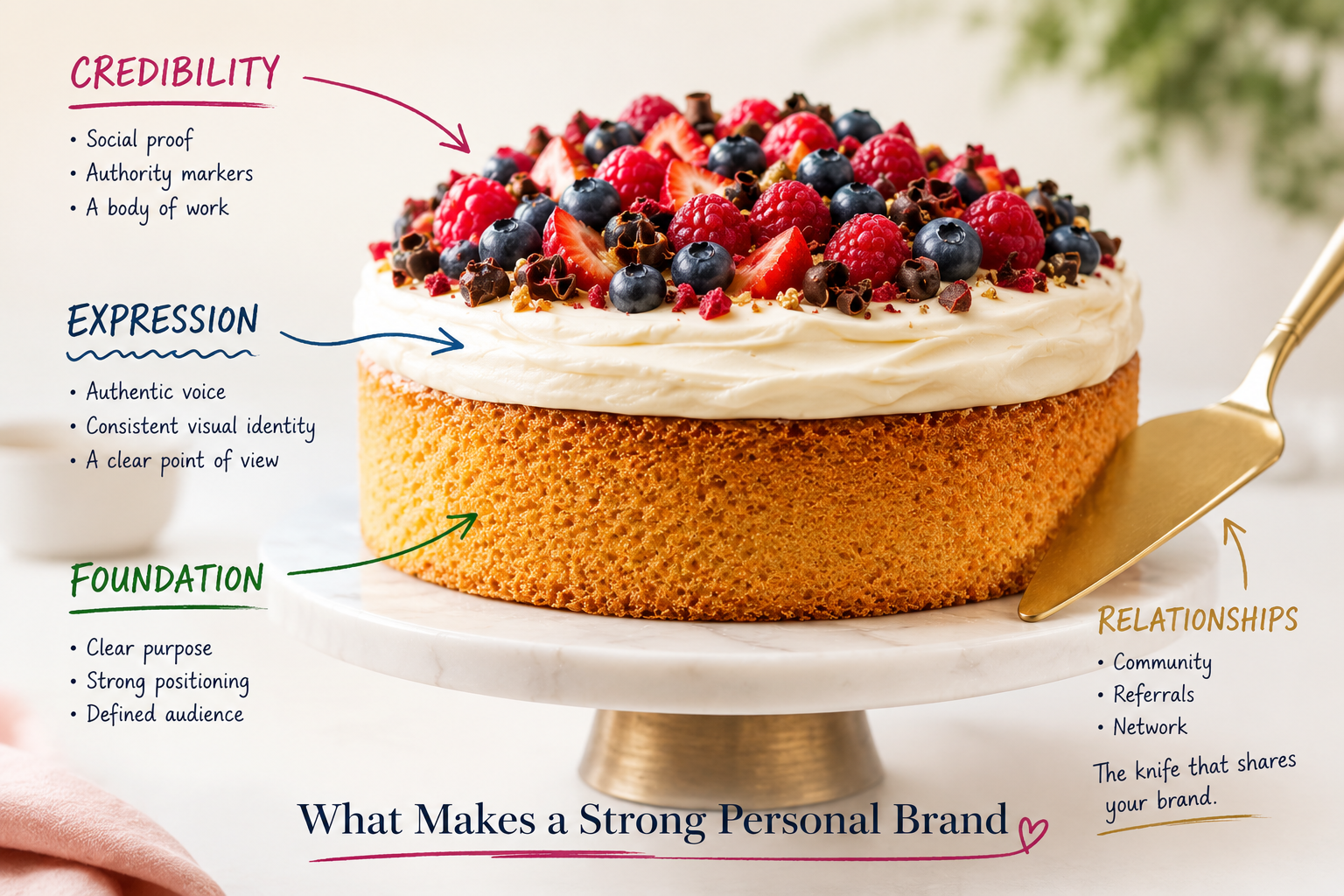
In my brand work, I teach it like a creating the best cake you've ever had. We look at four elements: foundation, expression, credibility and relationships. They're simple, but they're not shallow.
1. Foundation
Foundation is your brand clarity. It's your purpose, positioning, audience and core message.
When this is unclear, everything else starts compensating. Your content tries to explain too much. Your offers feel harder to describe. Your website becomes a polite maze.
2. Expression
Expression is how the brand shows up.
Your voice. Your visuals. Your point of view. The feeling people get when they read your words or sit in a room with you.
For a founder-led brand, expression matters because the founder isn't separate from the work. People are choosing your judgement, your standards and your way of seeing.
3. Credibility
Credibility is the evidence.
Testimonials, client stories, case studies, media features, years in practice, workshops, interviews, recognised clients, awards submissions, frameworks, body of work.
If the proof is there but hidden, your audience has to take too much on faith. Faith is lovely. Proof is more useful on a sales page.
4. Relationships
Relationships are how the brand travels.
Referrals. Word of mouth. Community. Podcast conversations. Collaborations. The quiet way people mention your name when someone asks, "Do you know anyone who can help with this?"
A trusted brand isn't only what you say about yourself. It's what other people can confidently repeat.
Clear doesn't mean obvious
There's a fear that if you make your message simple, you will flatten the depth.
I understand that fear.
When your work has nuance, simple can feel too small. You don't want to sound like everyone else. You don't want to squeeze years of experience into a sentence that feels like it came from a networking breakfast and left before coffee.
But clarity isn't the same as obviousness.
Clarity is respect.
It says, "I've done the work of distilling this so you don't have to carry the whole tangle with me."
That's what strong brand messaging does. It doesn't remove the depth. It gives the depth an entrance.
Why this matters for AI search too
People are asking more conversational questions now.
I know if they're looking for someone like me, they're not only typing "copywriter Melbourne" into Google. They're asking AI tools things like:
• Who can help me explain my message. I have service-based business?
• What is the difference between brand messaging and copywriting?
• How do I build my personal brand? Who's an expert in this area
• Who helps founders work out what their brand voice is in Melbourne?
AI systems need clear signals to answer those questions well.
That doesn't mean stuffing your website with keywords until it sounds like it needs fresh air.
It means making your public brand consistent enough that both people and search systems can understand the same thing:
This is who I'm. This is what I do. This is who I help. This is the proof. This is the work I want to be known for.
Here's how to do a small trust audit on your business
If you want to know whether your brand is building trust, look at the places people meet you first.
Your homepage: Can someone understand your work within a few seconds?
Your LinkedIn headline: Does it point to the same positioning as your website?
Your About page: Does it build trust, or does it hide behind a biography?
Your proof: Is it visible, current and connected to the promise you're making?
Your content: Is it building a recognisable body of thinking, or is it a drawer full of good ideas with no through-line?
The best way you can build brand trust
Trust is built in the small agreements across your brand.
The homepage agrees with the LinkedIn profile. The offer agrees with the proof. The voice agrees with the person. The content agrees with the work you want to be known for.
That's brand alignment. And notice I didn't say brand perfection. When those pieces start to agree, your market doesn't have to work so hard to choose you. Which is kinda the point.
Want to see what area of your business needs attention to build that trust with your audience?
Take the Brand Communication Check - it's 3min and you get an immediate result. It will show you whether your brand is building trust through clarity, or asking people to do too much interpretation. Gulp.