How to turn what you know into a brand people understand and recommend
Jul 06, 2026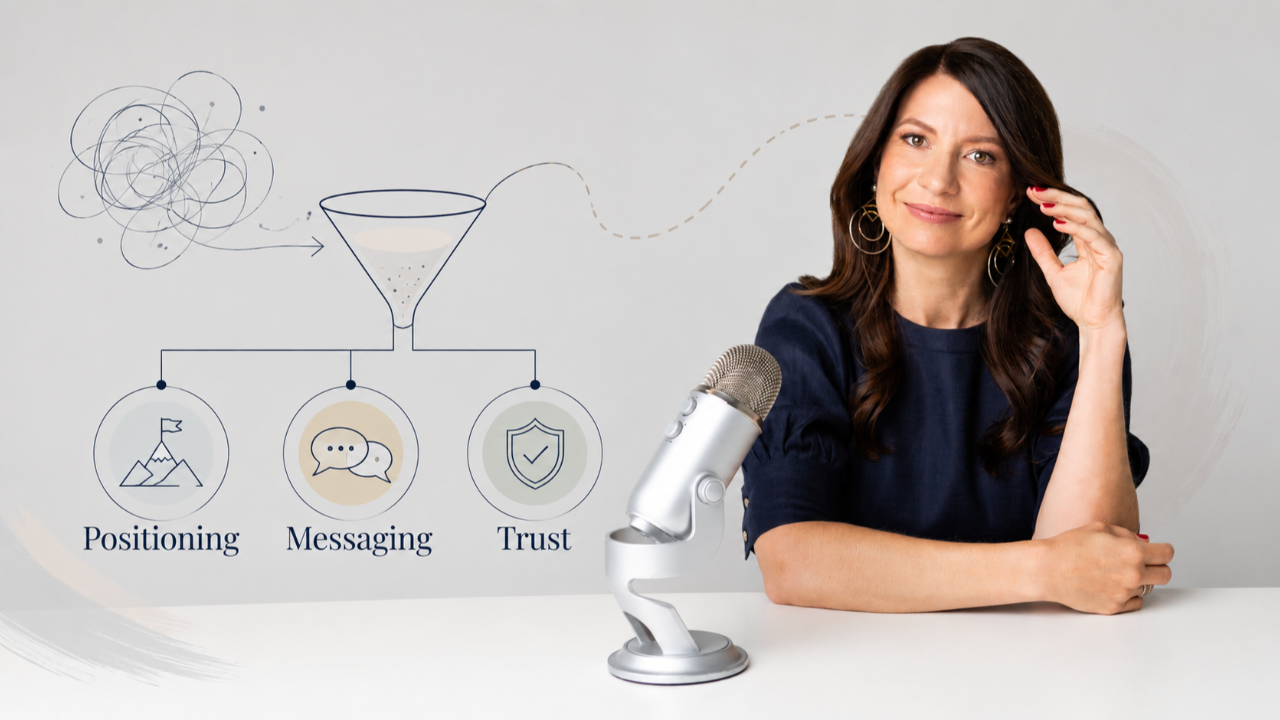
Your thinking is your edge when it comes to brand communication.
Not the Canva template. Not the font or your logo. And neither are the three slightly different versions of your bio sitting in a folder called "final final actually final”.
Your thinking includes the way you see the problem. The way you listen to a customer. The way you know, often before your client does, which part of the conversation actually matters. The quiet pattern you can spot because you have spent years inside your subject.
That's the part of your brand no one else can copy.
But here is the problem. Your thinking is only an edge if people can understand it.
If it stays in your head, it may be brilliant, but it's not doing much. It becomes a lovely private collection. Very exclusive. Nice for you to reference, but terrible for your business.
The gap between what you know and what people hear
Most founders I work with aren't short on intelligence or experience.
They know their work inside out. They genuinely care about it. Some of them can explain it beautifully once they're in a proper conversation with someone who is paying attention. For others, the trouble starts before that.
It starts on the homepage. The LinkedIn headline. The service page. The proposal introduction. The moment someone asks, "So what do you do?" and suddenly the your body stiffens, and it’s like you have no idea who you are anymore.
That gap isn't a personality flaw. It's usually a positioning problem.
Positioning is the act of distilling
Positioning isn't about making your business sound bigger or shinier than it actually is.
It's the act of distilling what’s already there. Positioning asks:
• What do I want to be known for?
• Who am I here to help?
• What problem do I see more clearly than my market does?
• What is the transformation underneath the service?
• What do people need to understand before they can trust me?
• And where does that all sit in my market?
When these answers are vague, every piece of communication you put out becomes a colossal essay you recruit AI to write on your behalf. But then you struggle because you’re not clear to begin with.
Look, if you’re trying to explain the offer, prove your credibility, show your personality, teach the client, calm their fear and somehow sound effortless - all in one go.
That's too much for one paragraph or an introduction.
Your market is looking for certainty
People don't choose you because you have the longest explanation. Also not the most concise.
They choose you when something resonates.
They read your words and feel, "Yes, this person sees the problem properly."
That's what strong founder-led brand positioning does. It gives your market a sense of certainty. Not hype. Not pressure. Certainty.
For my work, that centre is clarity around brand to help founders communicate from a place of strength and confidence. Because when I help founders position, package and communicate their value so their market understands, trusts and chooses them - things become easeful for them.
Because they’re leading from clarity, not ‘I think I know’. Not I ‘sort of know'. They operate from clarity around their brand and how to show up.
The part AI can't invent for you
AI can help you move faster.
I use it. I like it. I also think it has made a lot of people forget that writing isn't just output.
The part AI can't invent for you is the lived experience underneath your point of view. It can help shape what you give it, but it can't go and live life on your behalf.
This is why your thinking matters even more now.
As more brands publish more words, many are losing their edge, because there’s little to no depth. The lived experience isn’t capture. And visibility without YOU, your brand’s essence (everything you stand for and your personality) is just content. You don’t want to just create content for content’s sake.
For AI search, GEO and SEO, clarity still matters. Search systems need to understand what you do, who you help and why you're relevant. But if you only write for the system, humans can feel it. The copy gets that slightly laminated quality.
The goal isn't to choose between human writing and discoverability
It's to write clearly enough for both.
1. A simple way to test your positioning
Look at your homepage, LinkedIn headline or About page and ask:
2. Can someone repeat what I do after one read?
If they need to interpret too much, the positioning isn't yet doing its job.
3. Does my message show the way I think?
Not every thought. Please no. But enough for people to sense the mind behind the work.
4. Does my proof support the promise?
If you say you help people become clearer, show the frameworks, stories, client language, articles, testimonials or features that make that believable.
5. Does it sound like me?
Professional doesn't mean stripped of life. Your brand can sound intelligent and still have a pulse that likes to fly aerobatic aeroplanes and eat baked cheesecake on weekends - or is that just me?
The next best step to clarify your message
If your message feels harder than it should, don't start by rewriting everything.
Start by looking for the gap.
Is it clarity? Is it alignment? Is it the overthinking loop that starts when you know the work but don't yet trust the words?
That's what the Brand Communication Check is for. It gives you somewhere to begin, it reflect to you where you’re really at. Not a guessed version of this is where you think your brand isn’t clear. It will show you where. Precisely.
With the rise of AI, your thinking is your competitive edge - if you use it.
Your work is to turn that point of view into content that gets published and noticed by your audience.
Take the Brand Communication Check to see where your brand communication is clear, where it's getting tangled, and what to focus on first.